Surgical plume exposes UK theatre staff to carcinogens, viruses and ultrafine particles every day — yet the UK still has no mandatory evacuation law. Here's what every theatre team needs to know.
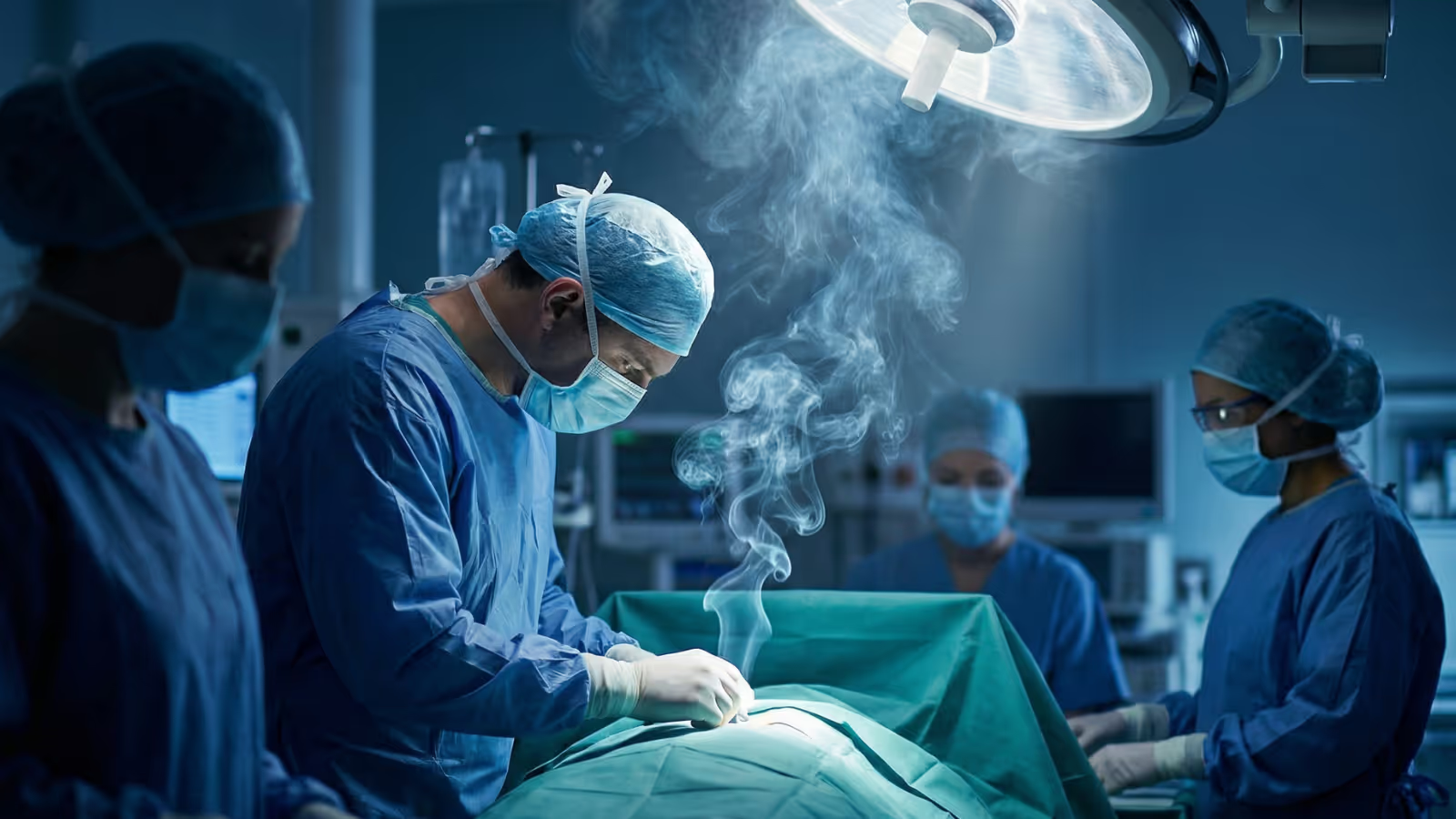
If you work in an operating theatre, you know the smell. That faint, acrid tang that rises from the surgical field the moment the diathermy pencil touches tissue. For decades, it has been treated as background noise — an unavoidable part of the job. It is not. That smell is surgical plume, and a growing body of evidence suggests it is one of the most under-recognised occupational hazards in modern healthcare.
While Denmark and twenty US states have now passed laws requiring hospitals to evacuate surgical plume at source, the UK still has no specific legislation. Theatre staff up and down the country continue to breathe it in, shift after shift, with little protection and even less training.
This article sets out what surgical plume actually is, what the research says about its risks, and why the UK needs to catch up with the rest of the world.
Surgical plume — also called diathermy plume or cautery plume — is the visible (and invisible) aerosol produced when heat-generating instruments are used on human tissue. Electrosurgical units, lasers, ultrasonic scalpels and harmonic devices all vaporise cellular tissue, and the resulting plume is released directly into the air of the operating theatre.
It is generated in almost every procedure that involves cutting, cauterising or coagulating. From routine laparoscopies and caesarean sections to tonsillectomies and LEEP procedures, plume is produced in volumes most staff never stop to consider.
It is tempting to think of plume as mostly steam. It is not. Around 95% of surgical plume is water vapour — but the remaining 5% is where the trouble lies. That fraction contains a cocktail of biological and chemical hazards, including:
In a study of patients undergoing laparoscopic cholecystectomy, researchers found significant levels of benzene and toluene in patients' urine post-operatively — confirming that plume by-products cross into the bloodstream of the person on the table, not just the people standing around it.
This is the statistic that tends to stop theatre staff in their tracks. Research suggests that one gram of surgical plume is equivalent in toxicity to smoking between three and six cigarettes. Given that several grams of plume are typically produced during an average procedure, staff working a standard list of five operations may be inhaling the toxic equivalent of 20 to 30 cigarettes a day.
Unlike smoking, of course, it is not a choice. And unlike cigarette smoke, nobody hands out health warnings at the theatre door.
Healthcare professionals working in operating theatres report roughly twice the incidence of respiratory problems compared with the general public. Symptoms range from chronic coughs, watery eyes and sore throats to asthma, bronchitis and, in some documented cases, interstitial lung disease. A 2022 UK survey of 955 perioperative practitioners found that 72% had experienced symptoms they associated with plume exposure — yet only 12% had ever formally reported them.
This is perhaps the most sobering area of research. Intact HPV DNA has been repeatedly identified in plume from LEEP (loop electrosurgical excision procedures) and laser ablation of warts or cervical lesions. Case reports now exist of surgeons developing HPV-positive tonsillar and oropharyngeal cancers with no other risk factors — most famously, two gynaecologists who had spent decades performing LEEPs and laser ablations and went on to develop HPV 16-positive tonsillar squamous cell carcinoma. A laser surgeon developed laryngeal papillomatosis after years of treating anogenital condylomas, and the HPV types in his laryngeal tissue matched those of his patients.
A study published in Scientific Reports estimated the lifetime cancer risk for surgeons from plume exposure at approximately 117 per million — a figure that vastly exceeds the acceptable occupational cancer risk thresholds used in most industries. Benzene alone, which has been detected at unacceptably high levels after just 30 minutes of laparoscopic surgery, is a known Group 1 carcinogen.
In laparoscopic surgery, plume collects inside the patient's abdominal cavity, where it can be absorbed through the peritoneum and later excreted. That means surgical plume is not purely a staff-safety issue — it is a patient-safety issue, particularly for long procedures.
This is where UK practice begins to diverge from the rest of the world.
The UK's Health and Safety Executive (HSE) acknowledges on its own website that diathermy emissions fall under the Control of Substances Hazardous to Health Regulations 2002 (COSHH). This means employers are legally required to carry out a risk assessment and, where exposure cannot be prevented, control it — typically through local exhaust ventilation (LEV) such as on-tip plume extraction.
The Medicines and Healthcare products Regulatory Agency (MHRA) recommends that plume evacuation systems should be used during laser surgery. The Association for Perioperative Practice (AfPP) has been campaigning on the issue for years and publishes its own standards. And the broader Health and Safety at Work Act 1974 places a general duty on employers to protect staff from foreseeable harm.
Yet despite all of this, there is no specific, mandatory UK regulation requiring the use of plume evacuation systems in any procedure that generates plume. A 2012 HSE literature review concluded there was "insufficient statistical data" to draw firm conclusions on causation, and little has changed in the framework since.
The result on the ground is predictable. The 2022 Surgical Plume Alliance report — a joint initiative between the AfPP and the International Council on Surgical Plume — surveyed nearly a thousand UK perioperative practitioners and found:
One of the largest NHS trusts contacted for an academic review stated plainly that it did not consider surgical plume to require a COSHH risk assessment at all.
The contrast with international practice is stark.
Denmark was among the first countries to act, introducing a regulation that makes it mandatory for employers to install extraction systems that remove plume and other harmful substances as close as possible to the source.
In the United States, while there is still no federal mandate, state-level legislation has advanced rapidly. As of 2026, 20 US states have enacted laws requiring hospitals and ambulatory surgical centres to use plume evacuation systems: Arizona, California, Colorado, Connecticut, Delaware, Georgia, Illinois, Kentucky, Louisiana, Minnesota, Missouri, New Jersey, New York, North Carolina, Ohio, Oregon, Rhode Island, Virginia, Washington and West Virginia. Rhode Island was the first to legislate in 2019, and the pace of new bills has accelerated year on year.
The European Operating Room Nurses Association (EORNA) recommends that operating rooms maintain 15–20 air changes per hour, use effective evacuation systems whenever plume-generating devices are in use, and provide appropriate PPE. Its recommendations are increasingly reflected in national guidance across Europe.
The UK, despite being one of the most research-active nations in perioperative medicine, has yet to follow.
Waiting for legislation is not the only option. There is a great deal that individual theatre teams, managers and trusts can do today:
Surgical plume is not a new problem. Papers warning about its hazards have been appearing in peer-reviewed journals since the late 1980s. What is new is that the rest of the world has begun to act — and UK theatre staff increasingly find themselves on the wrong side of an international safety gap that has nothing to do with the quality of their care and everything to do with regulatory inertia.
At Toffeln, we've spent more than 40 years focused on protecting the people who keep operating theatres running. Foot health was where we started, but the same principle applies across the board: no-one who walks into a theatre to save lives should be quietly harmed for doing so. Until the UK catches up with Denmark and the twenty US states that have legislated, that protection will have to be led by the teams themselves.
And the first step, as ever, is to stop treating that acrid smell as normal.
%20(RGB).svg)

.svg)
.svg)


.svg)